

Ok, I admit it: I watch the World Cup differently. I’m not so much of a football buff, although I’m getting sucked in through my children. Curiously, this is only the second post on the subject on this sparsely written blog (working on it), but the previous time was more of a metaphor, so that doesn’t count.
This post is about real football.
Or better: the ads around the football field. I watch them, and I’m sure most of you’ve seen them too.
They suck, and it puzzles me.
Advertisers pay millions to sponsor the FIFA World Cup. I know it’s all in packages, but part of those packages seems to include an ad on the screens around the field. Since the games are televised, these ads are shown on the world stage. A truly global audience. Seems like a good deal, but I have 3 problems with what I’m seeing: relevance, quality and clarity.
Problem 1: Relevance
There are ads for Coca-Cola, Qatar Airlines, Kia, Lays and Adidas to name a few of the sponsors I remember. I don’t have a relevance problem with those. These are global brands, we all know them.
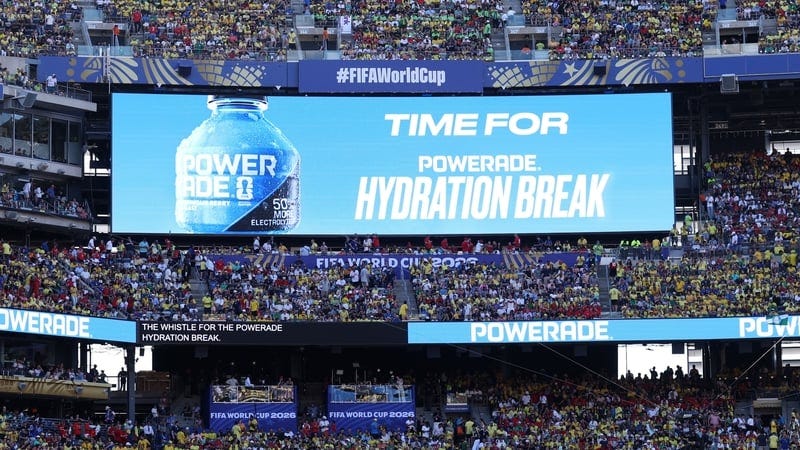
Powerade is doing even better. Now that the USA is hosting the tournament, we've suddenly been introduced to something called the Hydration Break. A small break cutting a game period in 2 for 3 minutes. The time is simply added back onto the clock. The explanation: give players time to hydrate. The reason behind it: a 3-minute ad-break on the American networks. Since this break is not an ad break in the rest of the world, we see some stadium shots, and the stadium is taken over by Powerade. Nicely done. Global brand. Super relevant. Whether football actually needs this break is another discussion.
And then there are others.
I have no idea what M-plus is, but judging by the characters it looks Asian. Not sure what to expect from it, and I’m sure the primary audience of the Portugal - Spain game does neither.

In an ideal world these ads are planned in relationship to the teams on the field. But for some reason this clearly isn’t the case. And sure, there are people watching everything (my kids), but if we can start looking at the countries the teams on the field represent as the core audience, that would already be a huge improvement.
There’s a ton of local brands on there as well. They’re paying for a big chunk of waste. How cool would it be if we could open this up to local brands around the world. A Spanish brand when Spain is playing, and only then. Less waste, more affordable and I believe even better commercial value for FIFA.
Extra point for Bank of America! They have an ad running that states: Serving Clients Globally. This makes it more relevant: ah this might be interesting for me as well. And then I saw that they even translated it into Spanish for the game of Spain vs Portugal: sirviendo al mundo (Serving The World). They also showed it when Brazil was playing Norway. Unfortunately, they speak Portuguese in Brazil, so that should have been: servindo o mundo, according to Google Translate. Fair enough, half a point for trying!

Problem 2: Quality
So you spent the aforementioned millions of dollars and you can show whatever you want. Then you missed the deadline, but luckily your secretary managed to send over your logo just in time. Phew!
There are some brands that make a minimum of effort to communicate nicely. Kia has a car that bumps into a football and let it roll over the display. Or the best one: McDonald’s has one using their jingle as a karaoke singalong, you really hear it! Ba da ba ba ba.

And then there’s Coca-Cola showing .. just their logo. And sometimes it blinks.
I’m afraid hardly any of the ads that are shown are made by an advertising agency. My guess is that this part of the budget isn't always managed by the brand marketing team, but by a sponsorship team or something. They don’t have these relationships with the ad agencies, and it seems they don’t find their way to it either. And that’s a pity.
We should treat them as micro-Super Bowl ads. The idea of the superbowl is, you pay a crazy amount of money to get the ad space. And now you want to get everything out of it, so you create a very good commercial to maximize the return for the money you just invested.
Why would this be different here? We need creativity, to get attention and be perceived as original and likable.
Problem 3: Clarity
What are you? What do you want people to know? To remember?
Especially with these non-global brands it’s a puzzle sometimes. Although there is an opportunity to make yourself known. By telling what you are.
Maybe the M-plus mentioned above is relevant for me .. I wouldn’t know.

Another one I see regularly is ADI Predictstreet - in partnership with Kalshi. I had to look it up: it’s sports betting. I could have guessed, but why not tell me. And why not make it relevant: “who do you think is going to win this game? ADIpredictstreet.com”.
I understand sometimes it’s more a political and PR exercise. Take Aramco .. I had no clue, but apparently it’s a regular FIFA sponsor. Aramco is the commercial brand name of the Saudi Arabian Oil Company. Corporate B2B branding in other words. In their case, they might even try to build their brand and reputation while keeping the general public in the dark. Sometimes clarity doesn’t help.

In short
Just treat this signage with the respect it deserves for what you’re paying for it. Try to reach a relevant audience, make it beautiful and distinctive, and if you’re not a world brand tell people what you are or what you want them to do.
Technology to score!?
There’s been an evolution obviously. These billboards used to be printed ones, now they are digital screens. That’s why they can feature a multitude of advertisers, but that’s not the only advantage.
In theory you should be able to load a data feed and use dynamic data and images, like we at our agency did for Samsung and ING. We had to develop some custom tech, but it’s perfectly doable. I’m also pretty sure all these screens have some kind of network access to load and schedule the ads. I’m just not sure if FIFA and/or the stadiums are ready and willing to open this up. Would be nice though.
However, there’s always a fallback scenario. At minimum you should be able to deliver a specific ad per game. So why not do something with that. Play into the situation. For example when Australia played Egypt, the local time in Egypt was 9PM and 4 AM in Australia. A message from McDonald’s could have been: Dinner in Cairo or Breakfast in Sydney.
Or why not use specific promo codes per game: order now at McDelivery and get a 20% discount with promocode AUS-EGY-26
The holy grail of technology of course is virtual perimeter advertising. Here the ads on the field are digitally replaced with local ads in each market. It’s a technology that’s been used before, but it doesn’t seem to be used at this World Cup.
Why bother? Does it even work?
I know, the majority of you are just looking at the games and not at the ads. So why would you even bother making the ads better.
It’s been researched, quite some time ago. In 1968 Robert Zajonc wrote about what he called the “mere exposure effect”. In short: repeated exposure increases liking, even when people do not consciously remember having seen the stimulus before. The stimulus in this case is an ad. Unlike a TV commercial, perimeter advertising isn't seen once. It's visible hundreds of times throughout a match. Robert Cialdini later discussed the same principle in Pre-Suasion. He explains that people can become more favourable towards a brand even when they have no conscious recall of seeing its advertising. So yes, people using all their attention to watch the game will have their effect too. At least, if people actually recognize it as your brand..
This may be the most valuable advertising space in sport. A single campaign is seen by hundreds of millions of viewers, repeatedly, over ninety minutes (and more). That's exactly why it deserves creative work that matches the investment. The medium evolved. The advertising didn't.
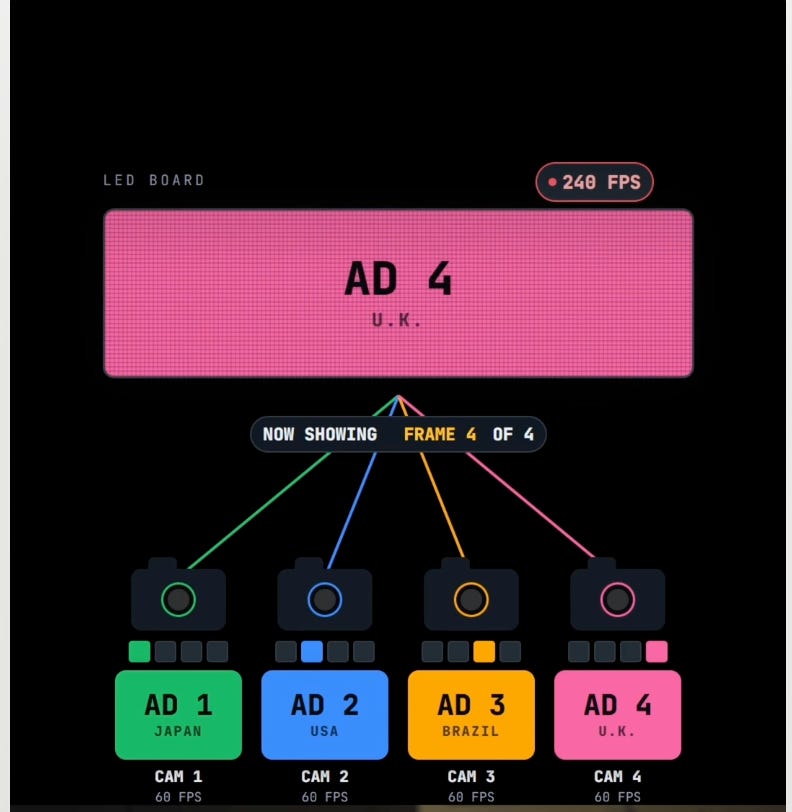
Update: One of my colleagues just showed me this reel. It's a different take on virtual perimeter advertising, using technology to localize ads. Instead of digitally replacing the ads between the camera feed and the local broadcast, it appears to display four different ads simultaneously on the LED boards using an extremely high refresh rate. By synchronizing the refresh rate with the cameras, each broadcast feed captures a different version of the ad for its own market. Super cool—although I have no idea whether this is actually how it works or if the reel is genuine. And I do wonder what it looks like to the people in the stadium. 😉
I’m Steven. I write about advertising and technology. I head AdSomeNoise, a new breed of full-service advertising agency with a digital core, based in Europe and operating globally. I’d love to get in touch.
The Levi’s Stadium logo cover-up made me wonder whether FIFA really faces the same pressures as most media owners.
They still seem to have enough leverage to dictate terms that would be unthinkable elsewhere, all in service of delivering exclusivity to the sponsors who paid for it. It feels like a different kind of business that the one we’re in.
That said, I agree with the broader point. It does make you wish someone, somewhere, cared a little more about the work itself.